

Harriet Connor

Author of Big Picture Parents

Search results: "1" (Page 1 of 15)

How Psalm 139 Made Me a Mother (Not Just a Parent)

Photo by Heather Mount on Unsplash

I grew up steeped in the value of gender equality. I can still remember a heated conversation around the coloring table at preschool—I was the kid arguing “There’s no such thing as girls’ colors and boys’ colors.” My all-girls high school had the unspoken motto of “Beat the boys.” We were encouraged to work hard and dream big; to become scientists, lawyers, and engineers. Our teachers rarely suggested traditionally female careers like teaching or nursing, and “the M word” (motherhood) was never mentioned.

Abigail Favale perfectly describes the kind of feminism I was raised in:

The classic feminist argument affirms sex role fluidity—a woman can do whatever a man can do. Thus, a different notion of woman’s essence is presupposed: namely, none. Instead, women and men become essentially interchangeable, essentially the same. Because a woman can do anything, she no longer is anything in particular.

As a result, I grew up very disconnected from my femaleness. Unlike other girls, I never wore pink. I never put on makeup. I never did my hair. Skirts, breasts, and menstrual periods were just minor inconveniences to be overcome in an effort to “beat the boys.”

Parenthood: Struggle for Equality

As a young adult, I thought that finding a compatible partner meant finding someone exactly like me—a man who shared not just the same values and beliefs, but the same interests and tastes, the same sense of humor and style of communication. I expected a partnership to involve two people working interchangeably toward their shared goals.

When I eventually got married and then pregnant, it was the first time I began to understand my female body as something intricately designed for a distinct purpose. And yet, once I had given birth to our first son, nursing seemed to be the only thing that distinguished my role from my husband’s. I had somehow come to parenthood with the idea that my husband’s and my relationship with our son would be more or less the same—our “parenting” would be equal and identical.

But things never seemed to work out that way. My husband’s approach to raising children was fundamentally different. At times, we had opposite beliefs about what our son needed from us. My husband thought he needed more independence, but I thought he needed more connection. He thought I was being too gentle, and I thought he was being too firm. Because of this, our family life felt like a struggle. Our innate tendencies were always pulling in different directions, making it hard to reach the elusive goal of “equality.”

Read More

Motherhood During the COVID-19 Pandemic

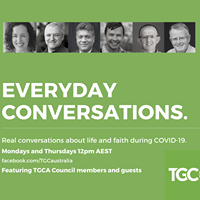
I had an encouraging chat with two of my mum friends about the joys and challenges of motherhood during the COVID-19 pandemic. This was part of the “Everyday Conversations” series from The Gospel Coalition Australia.

Watch the video here.

Interview with Hope 103.2

https://hope1032.com.au/stories/life/parenting/2017/no-mummy-guilt-ancient-wisdom-makes-parenting-peaceful/

Why I don’t want to teach my children about (just) consent

I generally enjoy watching the reality TV show Parental Guidance. It follows different sets of parents as they navigate a series of challenges with their children. Later on, the group evaluates how each family went, with the help of parenting expert Dr Justin Coulson. I’ve found watching the show to be a good way of reflecting on my own parenting.

But one episode of this year’s series left me with an uncomfortable feeling: the episode about consent. Consent seems to be the word that everyone is talking about. In 2024 the federal government launched a nationwide awareness campaign, including a suite of TV ads, called ‘Consent can’t wait’. At school, many of our older children are attending ‘respectful relationships’ seminars where consent is one of the key concepts. Our school leavers are heading off to formals and ‘after parties’, to ‘schoolies’ weeks and beyond.

On the ‘consent’ episode of Parental Guidance each set of parents was given a family discussion question that was meant to start a conversation about consent in various situations (not all of them sexual). It was clear that the overtly Christian or ‘traditional’ parents were extremely uncomfortable talking about sexual relationships with their teen/tween daughters. But the ‘moral’ of the episode was that all parents need to prioritise talking with their children about the topic of consent.

So why did I go away feeling uneasy about this?

I strongly believe that as Christian parents we need to be talking to our children about sex. If we don’t communicate God’s positive vision, our children will pick up a different view of sex from their peers or the internet. In our family, my husband and I have tried to be open and upfront in initiating conversations and answering questions about sex, marriage, relationships, puberty, pornography and so on.

But I have to confess that I’ve never talked with my children about ‘consent’ exactly. And to be honest, I don’t know if I really want to. Here’s why I don’t want to teach my children about (just) consent.

It’s a low bar … but a good start

Consent has become the only moral standard by which our modern society evaluates sexual activity between adults. Did both parties give their consent? If so, it doesn’t matter what happened or who did it.

According to the government’s campaign, ‘Sexual consent is a free, voluntary and informed agreement between people to participate in a sexual act. This agreement is only present when these people mutually and genuinely want to engage in that sexual act, and actively ensure their partner does too’.

Of course, I want my children to expect sexual activity to be mutual and consensual. That’s the Bible’s ideal too. In sex, as in all of life, Christians are people who seek the good of others. Song of Songs is a great example of a loving sexual relationship in which both the man and the woman take pleasure in the other person. The woman repeats, ‘I am my beloved’s and my beloved is mine’ (Song of Songs 6:3). This view of sexual mutuality and other-person-centredness is echoed in the New Testament when Paul writes:

‘The husband should fulfil his marital duty to his wife, and likewise the wife to her husband. The wife does not have authority over her own body but yields it to her husband. In the same way, the husband does not have authority over his own body but yields it to his wife.’ (1 Corinthians 7:3–4)

But the Bible’s view of sexual relationships is about so much more than just consent!

Read More

Prayer and its place in our families

Prayer is an essential part of the Christian life—but it can be challenging for parents and children alike. How can we make prayer a part of our routine throughout the different stages of family life?

In this episode of Timeless Parenting we got practical about prayer with our guest, author and mother-of-three Wendy Lin. We spoke about how we experienced (or didn’t experience) Christian prayer in our families of origin and how we decided to approach it with our own children. We set the scene by discussing the questions ‘What is prayer?’ and ‘Why should we pray if God already knows everything?’. We then shared insights and practical ideas about:

  • How can we practise both routine and spontaneous prayer?
  • How does God answer prayer?
  • How can we do family prayer when we’re not confident?
  • What should we do if our spouse is not a keen Christian?
  • How can busy parents find time for personal prayer?

This conversation is insightful, practical, encouraging and full of grace for families in every season of life! You won’t hear a lot of ‘shoulds’, but rather a whole range of ideas that you could try out with your family.

You can also find our podcast on SpotifyApple Podcasts and other platforms.

Mothers Union Sydney runs an annual seminar about Christian life and parenting: The Joy of Enough, February 27, 2026.

Timeless Parenting is brought to you by Growing Faith, a ministry of Youthworks Media and Mothers Union Sydney.

Parenting when our days are numbered

Grief is weighing heavily on my local community at the moment. A few families have been visited by that most unwelcome and cold-hearted of intruders—death. It has been mercilessly tearing fathers and mothers away from their children far too soon.

A couple of weeks ago, a local dad had an out-of-the-blue medical episode and died quite suddenly, leaving a wife and four children behind. While our community was still coming to terms with that loss, the news came in that another local parent, whose kids are still in primary school, had been transferred to a palliative care unit.

Beyond that, the global Christian community is still reeling from the very public death of American conservative activist and father-of-two Charlie Kirk.

All of those families are facing the unthinkable: the fact that one day we will die and leave our children behind. It’s every parent’s worst nightmare.

We may have many more years with our children, or we may have fewer than we expect. We may have a slow departure, with time to say goodbye or we may pass away quite unexpectedly. But the fact remains: no parent lives forever. And the past few weeks have taught us that we never know how soon—or how suddenly—our time on earth might be up.

So how might we raise our children today in the light of our mortality?

 Lord, you have been our dwelling-place
throughout all generations.
Before the mountains were born
or you brought forth the whole world,
from everlasting to everlasting you are God.

You turn people back to dust,
saying, ‘Return to dust, you mortals’.
A thousand years in your sight
are like a day that has just gone by,
or like a watch in the night.
Yet you sweep people away in the sleep of death—
they are like the new grass of the morning:
In the morning it springs up new,
but by evening it is dry and withered …

Teach us to number our days,
that we may gain a heart of wisdom. (Psalm 90:1–6, 12)

Entrust our kids to God … starting now

Parenthood is one long exercise of faith. From the moment we see those two lines on a pregnancy test, we realise how much is out of our control—from our children’s safe delivery to their health, to their developmental milestones, to their friendships, school life and mental health … there are many times when we’re just anxiously, helplessly praying our way through the day. We can research and investigate, we can make plans and appointments, but ultimately, at least half of parenting is learning to wait and watch in faith.

Facing up to our mortality reminds us that we always need to hand our children over to God. They were never really ours to begin with. God gives us children to birth and care for during the short span of our life on earth, but he is their true Creator and sustainer. God is good and, unlike us, God is in control. So, like Abraham did with Isaac, we need to offer our children up into God’s loving arms—today and every day.

Read More

Timeless Parenting – latest conversations

Through co-hosting the Timeless Parenting podcast, I’ve had the privilege of talking with lots of interesting and well-thought-out Christians about issues that relate to family life. Some of our recent conversations have been about:

I hope these conversations will equip and encourage you too!

—-

Timeless Parenting is a collaboration between Growing Faith and Mothers Union Sydney. Find all of our episodes on your favourite podcast platform or here:

Timeless Parenting on Transistor.

The what, why and how of discipline

Discipline is probably the most difficult—and divisive—area of parenting, even among Christians. At some point every parent wonders: Are we disciplining our children enough? Or perhaps too much? Are we too lenient? Or perhaps too strict?

Our society usually equates discipline with punishment—a response to bad behaviour. But the Bible’s definition is much broader than that. Understanding biblical discipline begins with knowing God, the only perfect Father, who lovingly disciplines his children for their growth in godliness. In the light of this, the Bible describes parental discipline in terms of a loving, intentional, wholistic and long-term process that involves modelling, encouraging, teaching, training and correcting our children to help them mature towards godliness.

In this episode we speak with author and mum of five, Jocelyn Loane, taking a deep-dive into what biblical discipline really means.

We talk about:

  • What is discipline, according to the Bible?
  • Why do parents need to discipline their children?
  • How can discipline go wrong?
  • Is it OK for Christian parents to smack (or not to smack) their children?
  • How should we understand the ‘rod of discipline’ described in Proverbs?
  • How can we best respond to our children’s bad behaviour?

This conversation will be valuable for any Christian parent who wants to better understand the what, why and how of biblical discipline.

Further reading:

Parenting in God’s Family: Biblical Wisdom for Everyday Issues, which contains a chapter on ‘Discipline as discipleship’ by Harriet Connor.

Motherhood: How the Gospel Shapes Our Purpose and Priorities by Jocelyn Loane, which has two chapters devoted to the topic of discipline.

You can also find our podcast on SpotifyApple Podcasts and other platforms.

Mothers Union Sydney runs an annual seminar about Christian life and parenting. Listen to talks from previous seminars on Soundcloud.

Gender differences: generalisations are not stereotypes

In recent years it has become taboo to talk about the differences between men and women, especially those that appear to reflect negatively on women. Some people fear that any admission of difference will lead to discrimination against women and the limitation of their freedom. Another concern is that any generalisation about men and women could become a harmful stereotype used to justify mistreatment or exclusion. Finally, many people have become reticent to articulate any general gender differences lest they alienate those whose experience or expression of gender is atypical.

Most Christians agree that men and women are different, but very few are comfortable explaining how they differ. For some, this is because they do not want to go beyond what they consider the explicit teaching of Scripture. Others assume that any generalisation made about men and women must be a damaging and universalising stereotype. In this article I want to suggest that when gender differences are carefully observed, explored and discussed it is actually helpful. It can lead us to appreciate one another, help each other, work well together and, ultimately, give glory to the God who created us.

I grew up in a family where gender stereotypes were consistently overturned. My mother was (and still is) a full-time career woman who climbed to the top of the corporate ladder in a traditionally male field—construction. Mum would come home complaining about the men she worked with, listing off the things that men were simply incapable of doing—just like she’d read about in the classic book Men Are from Mars, Women Are from Venus. My sister and I would question, “But what about Dad?” (who is the opposite of your ‘typical Aussie bloke’). Mum would just laugh and reply, “Oh he doesn’t count!”

Having no brothers, and a dad who “didn’t count”, it was quite a shock when I got married and ended up with four sons. Sometimes I did feel like I was in a house full of people from another planet. The way my husband tended to approach parenting didn’t make sense to me. And the way my sons thought, played and communicated often baffled, even upset me. So in my own family life I have found it immensely helpful to learn about the general differences between men and women, boys and girls, mothers and fathers, so that instead of being baffled, frustrated or disappointed by the males in my life, I can start to appreciate and rejoice in our differences.

It’s OK to observe reality

It is important to recognise that there is a significant difference between a stereotype and a generalisation. A stereotype is an absolute exaggerated categorisation of an entire group of people, with no room for nuance or exceptions. For example, “Germans don’t have a sense of humour”, “Women are intuitive and empathetic” or “Men are better at maths”. A stereotype usually implies a judgement of one group as superior/inferior to another or an evaluation of an individual’s behaviour as normal/abnormal. Such statements can indeed be harmful. By contrast, a generalisation about gender differences is simply an observation about what is generally true for most people, usually based on extensive personal experience and/or scientific research. Importantly, there is no “ought” to be derived from making a general “is” statement about men and women.

Read More

How conflict offers opportunities for growth

Christians are meant to be people of peace, right? We follow the Prince of Peace; he calls us to be peacemakers; the fruit of the Holy Spirit includes love, joy and peace. And yet, we still seem to experience conflict in our churches and families. Our kids fight, we have arguments with our teens, and conflict plagues our marriages too. Sure, the neighbours may not hear us, but we know that our homes aren’t always places of peace.

We tend to default to the way that conflict was managed in the families we grew up in. Were difficult issues avoided and swept under the rug? Did one person always get their way? Were voices often raised? These patterns can shape our own response to conflict.

In this episode of Timeless Parenting our guest Jane Gibb, an experienced life and conflict coach, helps us to consider a Christian approach to conflict, especially within marriages and families. In particular, we talk about the opportunities that conflict offers—it can be a catalyst for personal growth and stronger, deeper relationships. We cover questions like:

  • What is conflict?
  • Is it normal for Christians to experience conflict?
  • What are the different ways people naturally respond to conflict and why?
  • Where do we experience conflict in our families?
  • What steps can we take to work through personal conflict in a healthy way?
  • What are some principles for managing conflict in our marriages?
  • How can we teach our children to manage conflict well?

This is a very insightful, practical and wide-ranging conversation—you might even want to take notes! You can find further resources for you and your children at Peacewise.


You can also find our podcast on SpotifyApple Podcasts and other platforms.

Mothers Union Sydney runs an annual seminar about Christian life and parenting. Listen to talks from previous seminars on Soundcloud.

If you want to get in touch with us to offer some feedback or suggest a topic, you can write to us at: timelessparenting@youthworks.net

Timeless Parenting is brought to you by Growing Faith, a ministry of Youthworks Media, and Mothers Union Sydney.

Page 1 of 15

Powered by WordPress & Theme by Anders Norén